For six years, WKCD.org has included a regular feature, Kids on the Wire. Every day, WKCD researcher Montana Miller scans newspapers nationwide for stories that testify to the dynamism and invaluable contributions of teenagers across the country. Occasionally, we like to step back and look at the stories that have caught our eye. Here are highlights from November ‘08—as good a reminder as any of the civic-mindedness and aspirations of today’s youth.
Friday, November 28, 2008 — Food Drives Run by Student Volunteers Help Nonprofits Fill Empty Bellies.
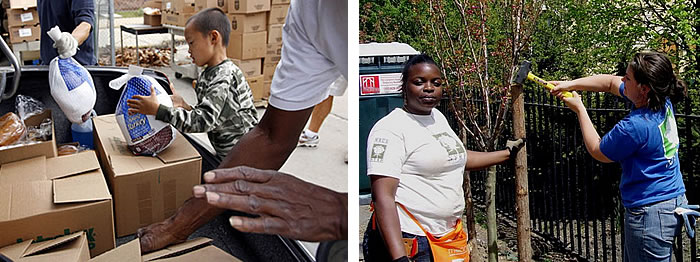
MORRIS TOWNSHIP, NJ: The bird brigade started in Montville, where volunteers bundled 60 turkeys into baskets to be distributed to local families. Next, they traveled to the Morristown area and unloaded almost 700 birds at the Interfaith Food Pantry and Market Street Mission before heading to Paterson and dropping off 500 frozen turkeys at the Father English Community Center. In all, a group of Kinnelon High School students and volunteers from Montville UNICO recently delivered more than 1,200 turkeys that the kids purchased through a letter-writing campaign. This year, student-run food drives and other service projects are filling a crucial need. With the stock market cratering and job losses mounting, food pantries and soup kitchens say they are seeing more clients but receiving fewer donations than in years past. "They're an absolute blessing," Rosemary Gilmartin, director of the Interfaith Food Pantry, said of the Kinnelon kids. "By them pulling together, they make a difference. You know you can count on them." Delbarton School students collected 18 tons of canned goods -- loading a tractor-trailer with nonperishable fruit, vegetables, tuna, chili and soup — to fill the bare shelves at the Community Soup Kitchen in Morristown this week. 130 students in the Franklin High School Key Club serve two to three times a week at Elijah's Promise food bank in New Brunswick, work at the food bank sorting and stocking food, and volunteer in recreational therapy for patients at Children's Specialized Hospital. Students will also be doing shifts of bell ringing for the Salvation Army. In Kinnelon, the group of high school students who call themselves Turkeys 4U collected $16,500 from friends and family and purchased 1,260 turkeys from a farm in Pennsylvania, said Steven Silvestri, co-president of Turkeys 4U and a senior at Kinnelon High. Silvestri said the program has taught him that many food bank and soup kitchen clients are the working poor, and the high cost of living in Morris County makes it difficult for some families to make ends meet. "They're not looking for handouts," he said. "They really need a little help to get by with their families.”
For FULL STORY, go to: the New Jersey Star-Ledger, 11/26/08
http://www.nj.com/helpinghands/carlyrothman/index.ssf/2008/11/food_drives_run_by_student_vol.html
Tuesday, November 25, 2008 — Youths Propel a Push Toward Volunteerism.
LEOMINSTER, MA: President-elect Barack Obama rode a spirit of civic engagement among young people to victory, harnessing a hunger for service and belonging that was sweeping across the nation's high schools, college campuses, and online communities. But that hunger had been building long before Obama launched his campaign, and it is poised to continue growing long after he has left the White House. Today's teenagers and young adults, thanks to encouragement from their baby boomer parents, an Internet revolution that makes the world feel smaller every day, and a growing number of service and nonprofit-career preparation programs at colleges, are far more likely than their predecessors to seek out ways to give back and to shape the world they will inherit. "Volunteerism is becoming a culture," said Sejal Hathi, a 17-year-old high school senior from Fremont, Calif., who founded an organization, Girls Helping Girls, to empower females around the world. This service ethic is evident nationwide - inspiring middle-school students to raise arts scholarship money for their needy peers; driving college students to craft programs combating youth violence and promoting small loans to entrepreneurs; and moving 20- and 30-somethings to create internationally focused nonprofit organizations. American teenagers today are 100 percent more likely to volunteer than teenagers in the last few decades, federal research shows. A record 68 percent of K-12 schools offer or recognize service opportunities for students. A survey by UCLA's Higher Education Research Institute found that two-thirds of students entering college in 2006 felt that helping others in need was essential or very important, the highest rate in 26 years. Steven Culbertson, president of Youth Service America, noted that young people have grown up with the Sept. 11, 2001, terrorist attacks, high-profile natural disasters, and the threat of climate change. "They've moved beyond planting tulips and painting murals to really engage on some of the biggest problems facing the world," Culbertson said.
For FULL STORY, go to: the Boston Globe, 11/24/08
http://www.boston.com/news/education/k_12/articles/2008/11/24/youths_propel_a_push_toward_volunteerism/?page=full
Monday, November 24, 2008 — Mestizo Project On the Move: Youth Rally Around University Research.
SALT LAKE CITY, UT: Laura Cobián, a sophomore at West High School, noticed last January that state lawmakers were discussing ways to curb employment and housing opportunities for undocumented workers through Senate Bill 81. Over in the House of Representatives, some lawmakers were looking to end in-state tuition for the children of undocumented workers with House Bill 241. "All this is happening," thought Cobián, "and no one in my school is talking about it." Then she launched the Mestizo Arts and Activism Project, an education and leadership program for Salt Lake City west-side youth. At the project's open-house last week, youth participants presented research projects that included activist blogs and community art work. The project is a mix of youth activism that wraps social research, art, academia and community change around the core of Salt Lake City's west side. Originated in the offices of University of Utah academics and administrators, the project aims to build on west-side community projects of the past while allowing young people to direct their research themselves. The project began in January 2007 with the selection of 18 West High School students. So far, students have created art projects and DVDs documenting the effects of stereotyping in school and the challenges facing undocumented students. An online program informs undocumented students of their rights under state law and opportunities for receiving tuition aid not tied to federal funds, which are available only to U.S. citizens. The documentary about undocumented students was pared down to 5 minutes from its original 20 and distributed to key state lawmakers during the last legislative session. "This project is a model of reciprocity and exchange. Academics aren't going to ask the same questions as youth in the community," said university professor Caitlin Cahill. "There's not that many spaces in their lives where they're able to talk about these things. "What's striking to me is that these young people are concerned about some of the most urgent social issues of our time -- immigration, discrimination and equity."
For FULL STORY, go to: the Salt Lake Tribune, 11/23/08
Friday, November 21, 2008 — Teens Use Green Thumbs to Improve New Haven
NEW HAVEN, CT: Both Governor Rell and President Elect Obama are looking into green collar jobs as a way to help develop a sustainable economy. But a non-profit group in New Haven is way ahead of them. The Urban Resources Initiative is wrapping up an unusual program that trains New Haven teens to improve the city environment, and themselves. It’s a damp Friday afternoon on a tree-lined street in the Westville section of New Haven. Most people are wrapping up their work week. But a group of teens from the Common Ground High School is just digging in. “Do you think it’s wide enough?” “I think it’s deep enough, probably not wide enough.” Emily Alcott, a first year grad student at the Yale School of Forestry and Environmental Studies, is supervising the work of two 15 year olds, Terrence Walker and Dimitri Lemonas. “We need to go wider.” “Let’s do it!” The two young men stab their shovels into hard turf to make a hole big enough to hold the roots of a Kwanzan cherry, an ornamental tree with double pink blossom that can grow 25 feet high. Alison Schleifer whose house looks out on the tree, has been waiting a long time for the city to replace a Linden tree that died. “They were going to and they were going to and they were going to, but this was 15-20 years ago. It never got planted. “But now it is. Working with the Urban Resources Initiative Schleifer had a choice about the type of tree in exchange for promising to take care of it. A grant from the U.S. Environmental Protection Agency is paying the Yale interns and the high school students. The City of New Haven pays for the trees.
For FULL STORY and AUDIO, got to: WNPR (Connecticut Public Radio), 11/21/08
Thursday, November 13, 2008 — High School Students Build a Cloud Chamber.
BRANDON, SD: When high school science teacher Steve Boint put out a call to students interested in building a cloud chamber to photograph subatomic radioactive particles flying through the school, he wasn’t sure if he’d generate any interest at all. Turns out, six to 10 high schoolers – depending on their Thursday after-school schedules – were intrigued by the invitation. “These are kids who think that the meaning of life is understanding it,” Boint said. “I’ve been wanting for a long time to have a cloud chamber to show students that particles do fly around here and, actually, building is better than buying.” Why are Boint and the small group of student scientists concerned if subatomic radioactive particles are flying through Brandon Valley High? “It’s not really that we care if there’s a small amount of radioactive particles flying around, we’re just studying the radioactive particles,” said Kyle Larson, a junior member of the group. In the four weeks the group has met, an aquarium-like box has been fitted with some of the needed elements. “I think their biggest challenge will be sealing it airtight with caulking,” Boint said. “Dealing with cold temperatures is the biggest technical challenge they’ll have.” By building the cloud chamber themselves the district is saving from $225 up to $1,000. About the only expense the project will incur is the cost of dry ice and pure alcohol. Dry ice will be placed underneath the chamber and an alcohol-soaked material will be laid across the top of the chamber. As the alcohol falls down, the temperature gradient will cause a fog. From that fog, the students will be able to track particles traveling through droplets that will form a line. Once the construction of the cloud chamber is accomplished, “we’ll shut off the lights, huddle around it and wait 15 to 20 minutes to see if we have any particles, and that will verify there is stuff flying around we can’t see,” Boint said.
For FULL STORY, go to: BrandonInfo.com, 11/13/08
Sunday, November 09, 2008 — Obama Victory Inspires Harlem Students.
NEW YORK, NY: Hope is in the air at the predominantly black public middle school just a day after Sen. Barack Obama made history as the first African-American elected president of the United States. Students are buzzing with excitement. Fifth-grade students are eager to talk about what the historic election means to them, how Obama inspires them and their expectations for him as the nation's next president. "We need some new ideas, and I think Barack Obama is the right man to do that," said Malcolm Mitchell, 11. "He kinda motivated me because looking at the past, people say, 'black men can't do this; black men can't do that.' ... You know, he's changing time, little by little. Women can vote now, and he's the first African-American president." Malcolm says he's also shared his thoughts about this year's election with other kids on Nick.com, the Web site for the children's television network Nickelodeon. Earlier in the week, the school had a mock election, which Obama won by landslide. Teachers say the kids have paid attention to this election. Some went to the polls to watch their parents vote, and many were awake until the wee hours of election night because of honking horns as people celebrated Obama's victory in the streets. Like many Americans, presumably echoing the concerns of their parents, the students told CNN their top issues are the economy, health care, race relations, the environment and the Iraq war. "[When] Barack Obama becomes president, he can stop the war," said Kaish Bhuyian, 10, whose parents are from Bangladesh. "I want him to help some black people and white people to get together and share." Of the 425 students at the middle school, 80 percent are black, 17 percent are Hispanic, and 3 percent are white or Asian. But Koolie Brown, 11, is quick to point out that both blacks and whites voted for Obama in the national election, because, he says, they believe he represents change. "I think Barack Obama should make a speech about [how to] stop climate change and to make more foundations for people who are poor and to help people [with cancer] so they can find a cure," said Michael Rosa, 10. "I feel that Obama is going to be a very good president because he is very brave, intelligent and successful, and he gives me the courage to go out there and be the first girl president of the United States," said Fatoumata Gakou, 11.
For FULL STORY, go to: CNN.com, 11/7/08
Wednesday, November 05, 2008 — High School Students Head to the Polls as Volunteers.
LOS ANGELES, CA: In Tuesday's historic election in which the votes of young people were expected to be pivotal, thousands of Los Angeles County high school students mostly tasted their first civic duty as poll workers -- not as voters. In 2000, 617 students participated in the student volunteer program. This year more than 4,200 worked Los Angeles County polls, with more than 3,100 others helping to inspect ballots after the polls closed. Students can earn extra credit and are paid $80 for their labor (plus an extra $20 if they attended a training session). The county's volunteer program began in 1998, and the 2000 election was the first presidential contest in which high school students could participate. To volunteer, students must be 16, a U.S. citizen, have at least a 2.5 grade point average and must have permission from parents and their school. The students got a first-hand look at democracy in action and gained experience that might make an impression on a college application. But they have also become an essential part of the county's 25,000-strong election day army of workers. "The good thing about students is they're in a learning mode," said Marcia Ventura, a spokeswoman for the Los Angeles County registrar-recorder, adding that they are more likely to show up, are more tech savvy and many are bilingual. "For veteran poll workers they bring an enthusiasm to the process, and for elderly workers they can help set up tables and equipment. Hopefully, they come out with a better understanding of the election process." Students from 216 schools, both public and private, participated in Tuesday's election. Alex Osborne, 17, a Pacific Hills senior, said his parents were surprised when he told them he wanted to volunteer at the polls. "I feel like it's a special election to be working in because of its nature," Osborne said. "I'm sorry I can't vote today, but my time will come."
For FULL STORY, go to: the Los Angeles Times, 11/5/08
http://www.latimes.com/news/education/la-me-student5-2008nov05,0,5366042.story